How Can Data Science Help Businesses Make Smarter Decisions?
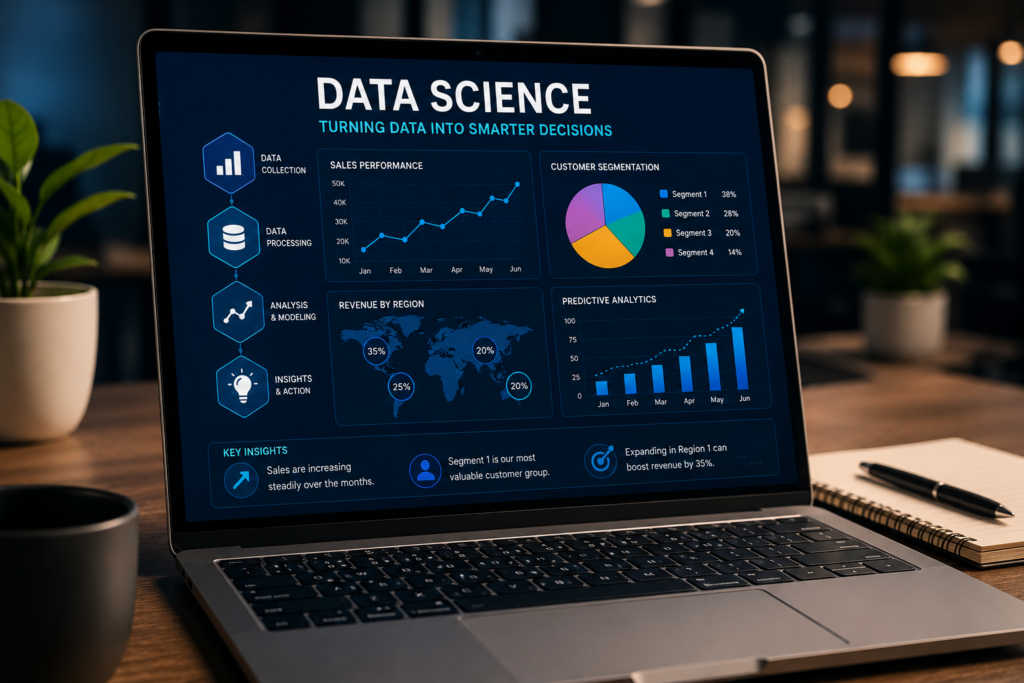
Businesses produce a tremendous amount of data daily. All of these interactions with customers, financial reports, operational records, social media, and website visits provide valuable data. But gathering data isn’t always enough for improved business decisions. They must learn how to find out what the information is, how to detect any identifiable patterns, and how to convert the information into a useful action. This is where data science can prove helpful.
Data science is an amalgamation of statistical analysis, programming, mathematics, machine learning, and domain knowledge to derive useful insights from structured and unstructured data. The information gained from these insights can be used to inform companies about their customers, enhance their work processes, identify potential risks, predict trends, and uncover new opportunities. With the growing digitisation of businesses, working well with data can be a critical factor in the success of the business.
What is Data Science and Why is it Important?
Data science is a multidisciplinary area that aims to derive knowledge and valuable insights from data. It’s all about gathering, cleaning, analyzing, visualizing, and modeling data to answer questions or solve business problems.
Data science, as opposed to traditional reporting that may describe past events, can help organizations explore the reasons behind what happened and make predictions about the future. Businesses can use machine learning models, statistical methods, and predictive analytics to evidence-inform decision-making.
Data science has become more relevant with the increasing access to organisations to larger data sets and more diversity. The ability to turn raw data into information that can be translated into action can help businesses stay ahead of the curve.
How Can Data Science Enhance Business Decision-Making?
One of the greatest value-adds of data science is that it provides a way to evidence-based decision-making. Rather than taking things on faith or on gut feeling, managers can analyze the data and gain insight into various scenarios.
For instance, a retailer can study the pattern of purchases and discover what products are the most in demand throughout different seasons. By analyzing the results of their campaigns, a marketing team can gauge which are more effective in driving engagement. A logistics firm will be able to review delivery data and recognize repeated delays.
These understandings enable decision makers to consider situations based on measurable evidence. Data will not remove uncertainty, but it can give a better base to make strategic decisions.
In What Ways Can Data Science be Used to Help Businesses Understand Their Customers?
It is an absolute requirement to know your customers to create products and services that will be a success. Organizations can leverage data science to understand their customers’ behavior, preferences, purchase history, and engagement patterns.
Segmentation techniques can be employed by businesses to break down the customer base into segments of comparable attributes or behaviors. This way, marketing teams can deliver more targeted campaigns and offers.
For instance, an online retailer could determine that some people are buying the same kind of product over and over. The company can then make appropriate recommendations or promotions to those customers.
Another benefit of using customer analytics is that it can help organisations gain insight into why customers leave a service. By recognizing patterns that relate to customer churn, businesses can create strategies to keep customers.
What is the Role of Predictive Analytics in Business Planning?
Data science has several interesting applications, one of which is predictive analytics. Uses historical data, statistics, and machine learning to predict outcomes.
Predictive models can be applied to businesses for demand forecasting, sales planning, inventory management, and financial analysis. For example, a retailer could use past sales and seasonal trends to predict the demand for a product.
Forecasting can help companies minimise avoidable stock holding costs and inventory risks. Similarly, financial teams can make use of predictive analysis to present possible revenue and costs.
Predictions are not guarantees, but can support organisations in planning for various scenarios.
What are Some Ways That Data Science can Enhance Marketing Strategies?
Marketing departments have the ability to have a lot of information about how customers interacted with them. Data science can assist marketers in understanding what works and what doesn’t in their campaigns, and set priorities for improvement.
Click-through rates, conversions, customer engagement, customer purchase behavior, and other metrics can be analysed. These ideas will assist marketers in budget planning.
Another aspect of the particular application is customer segmentation and recommendation systems, which enable marketing to be made more personalized. Organisations can write campaigns based on the properties of the audience and deliver different messages to different customers.
This can help save time on marketing processes and ensure that customers get information that is more relevant to their interests.
What are the Possibilities of Data Science to Create More Efficient Operations in Business?
Data science can also add value in terms of operational efficiency. Companies can use workflow analysis, resource utilization, production logs, and performance metrics to pinpoint inefficiencies.
For instance, if a manufacturing company uses machine data, they can find unusual patterns that may signal machine issues. Predictive maintenance models can assist businesses in planning maintenance ahead of the occurrence of failures.
Route analysis, traffic patterns, delivery times, and fuel usage can all be analyzed to enhance transportation planning.
Data analysis can help identify inefficiencies, which can lead to waste reduction and increased productivity and resource utilization.
What can Data Science do to Identify Business Risks?
All businesses have risks, such as financial loss, fraud, disruption of operations, and security issues, to name a few. Organizations can use data science to find unusual patterns and potential warning signs.
Software can, for instance, look into the behavior of transactions and detect any activity that is far removed from the norm. Analytical modelling can be used as a tool for financial institutions to assist risk assessment and monitoring.
In the same way, businesses can investigate their processes to determine those that often cause delays or failures.
Data science doesn’t remove risk from the equation, but it can offer a set of tools for identifying and addressing potential risks.
What is the Role of Machine Learning in Data Science?
Machine learning has been closely linked to data science and enables a computer to recognize patterns in data and make predictions without having to be told explicitly in each instance.
Supervised learning can be applied to classification and prediction problems, whereas unsupervised learning can be applied to find hidden patterns in data.
Recommendation systems, customer segmentation, fraud detection, demand forecasting, and numerous other applications are areas where machine learning can be used in businesses.
But machine learning is not a magic bullet and needs quality data, the right algorithms, testing, and ongoing monitoring. A model should not be considered automatically correct just because it is technologically sophisticated.
What is the Importance of Data Quality in Data Science?
Good analysis is dependent upon good data. When the data set is flawed, whether it has data inaccuracies, missing data, duplicate data, or stale data, the ensuing analysis may be incorrect.
Organizations need to have flow control for data collection, cleaning, validation, and maintenance. Data governance policies can be used to help establish the rules for storing, accessing, protecting, and using data.
Data cleaning can include deduplication, fixing inconsistencies or errors, filling in missing data, and normalizing formats.
There are many benefits of investing in data quality to ensure that the results of the analyses are more reliable and that the decision-maker can be more confident in the information he/she receives.
Skills Required for Data Science?
There is a need for both technical and analytical skills to become a data scientist. Statisticians, programmers, data analysts, machine learning experts, data visualizers, and database specialists are common professionals who use statistics.
Popular programming languages for data analysis and machine learning include Python and R. SQL is also crucial to the retrieval and management of data in relational databases.
Communication abilities are also crucial. A data professional needs to be able to communicate complicated information in a manner that can be understood by business leaders and other stakeholders.
The best data science projects tie in technical analysis with a business goal.
What are Some of the Challenges of Using Data Science in Business?
While data science is a great deal of help, there are several challenges to successfully implementing it. Issues of data quality, technical skills, infrastructure, privacy, and business goals can be challenges for organizations.
However, the other challenge is to correctly interpret analytical results. A correlation between two variables does not necessarily mean that one causes the other.
Businesses should thus use analytical tools alongside industry information and human expertise. Personal information should also be collected and analysed with a focus on ethics.
How can Businesses Start to Learn About Data Science?
Organizations don’t have to start a huge and complex project. One way to go is to look for a specific business problem that might be amenable to data analysis.
The company is then able to identify existing data and evaluate its quality, choose analytical techniques, and establish measurable goals.
Implementing a project that has a specific objective can help businesses to prove their value and build their analytical skills. If the projects are successful, they can be scaled up for larger data projects.
Conclusion
Data science can prove helpful to a business in making useful information out of a wealth of data for use in decision-making. It is used in a variety of aspects of today’s business, including customer analysis, marketing optimization, forecasting, operational efficiency, and risk identification.
But technology doesn’t mean success. These are essential for any organization to have – reliable data, appropriate analytical methods, skilled professionals, clear objectives, and responsible data practices.
By bringing these factors into play, data science can give businesses a better insight into their business and customers. Combining evidence with human experience and strategic planning can enable organisations to make better decisions and react to market shifts more effectively.